 The Hindu Story
A guide for beginners
The Mahabharata for beginners
The longest poem ever written, and one of the most human. Here is everything you need to begin, in about ten minutes.
What is the Mahabharata?
The Mahabharata is an ancient Indian epic, the story of a royal family that tears itself apart. Two groups of cousins, the five Pandavas and the hundred Kauravas, both claim the throne of Hastinapura. Their rivalry grows over a lifetime, through jealousy, a fateful game of dice, thirteen years of exile, and finally a war in which almost everyone dies.
It is also much more than a war story. Inside it are love stories, adventures, riddles, curses, gods walking among people, and long conversations about how to live well. Tradition says its author, the sage Vyasa, wrote of it: what is found here may be found elsewhere, but what is not found here is found nowhere.
How long is it?
Very long. In Sanskrit it runs to around 100,000 verses in its traditional count, many times longer than the Iliad and the Odyssey together. It is divided into 18 books, called parvas, each named for its main events.
That length is exactly why most people never finish it, and why we tell it as one short episode a day. Our telling runs for 365 episodes, a two-minute read each, so the whole story takes a year.
The story in brief
The family
King Shantanu of Hastinapura marries the river goddess Ganga, and their son becomes Bhishma, who swears never to marry or rule so that his father can marry Satyavati. Two generations later the family has two branches. Blind Dhritarashtra and Gandhari have a hundred sons, led by Duryodhana. His brother Pandu has five sons through the gods: Yudhishthira, Bhima, Arjuna, and the twins Nakula and Sahadeva.
The rivalry
The cousins grow up together and are trained by the great teacher Drona. The Pandavas shine; Duryodhana burns with jealousy. With his uncle Shakuni and his loyal friend Karna, he tries to poison Bhima and to burn the Pandavas alive. They escape, and Arjuna wins the princess Draupadi, who becomes the wife of all five brothers.
The game of dice
The Pandavas build a splendid kingdom of their own. Duryodhana invites Yudhishthira to play dice against Shakuni, and Yudhishthira loses everything: his kingdom, his brothers, himself, and Draupadi, who is dragged into the court and humiliated. The Pandavas are exiled for twelve years in the forest and a thirteenth in disguise.
The war
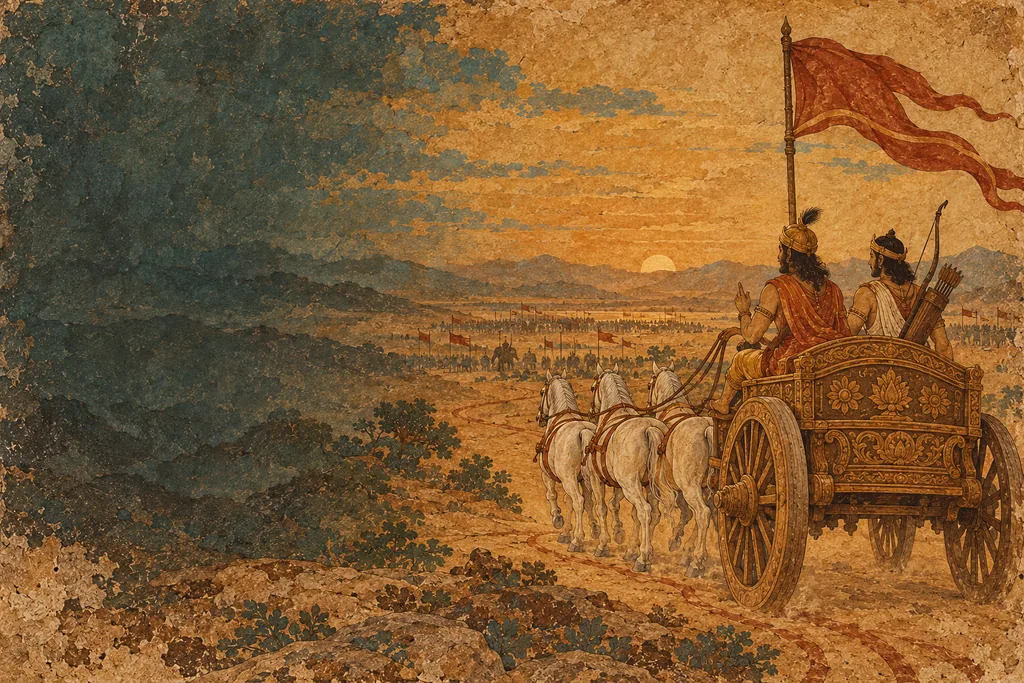
When they return, Duryodhana will not give back even five villages. The two sides gather their armies at Kurukshetra. Krishna, the Pandavas’ cousin and friend, becomes Arjuna’s charioteer. The battle lasts eighteen days, and by the end almost every great warrior on both sides is dead.
After the war (spoilers)
Yudhishthira becomes king, grieving more than celebrating. Years later, the Pandavas and Draupadi walk toward the Himalayas, and one by one they fall, until only Yudhishthira and a faithful dog reach the gates of heaven.
The main characters
You do not need to remember everyone. Five names will carry you a long way:
- Arjuna: the great archer, and the closest thing the story has to a hero.
- Krishna: his cousin, friend and guide, and the voice of the Bhagavad Gita.
- Draupadi: the fire-born queen whose humiliation makes the war certain.
- Duryodhana: the jealous eldest Kaurava who refuses to share.
- Karna: Duryodhana’s loyal friend, and the most tragic figure in the epic.
When you are ready for more, our guide to all the characters introduces each one the way the story does.
What is the Bhagavad Gita?
The Bhagavad Gita, "the song of the Lord," is a conversation of about 700 verses inside the Mahabharata. On the first morning of the war, Arjuna sees his teachers and cousins lined up against him and refuses to fight. Krishna answers him: what our duty is, what cannot die, how to act without being ruled by success or failure, and what it means to be devoted.
It is the most widely read part of the epic, and many people read it on its own. But it means much more when you know the whole story leading up to that moment, and that is how we tell it: in its place, as a scene in the story.
Is it a true story?
Many Hindus regard the Mahabharata as itihasa, "so it was": history in a traditional sense. Historians see it as an epic that grew over many centuries, built around memories of ancient kingdoms in northern India. Either way, its people feel real, which is why the story has lasted.
Do I need to know anything before I start?
Not at all. Many readers are meeting the Mahabharata for the first time. A good telling introduces every character as they arrive, so you can simply enjoy the story. A few words that help:
- Dharma: duty, rightness, the way things ought to be. Almost every choice in the epic is a question about dharma.
- Kuru: the royal family of Hastinapura. Both sides are Kurus.
- Pandavas: the five sons of Pandu.
- Kauravas: the hundred sons of Dhritarashtra.
- Rakshasa: a powerful being of the forest, often (not always) dangerous.
Where should a beginner start?
You have a few good choices:
- A short retelling. Several modern retellings tell the story in a few hundred pages. They are a fine start, though they leave out many of the side stories.
- A full translation. Kisari Mohan Ganguli’s English translation from the 1880s is complete and free to read online, but long and old-fashioned.
- One episode a day. The Hindu Story sends the whole Mahabharata as one short, illustrated email each morning, faithful to the full epic and easy to follow. It is how we wish we had first met the story. Read a sample episode to see if it suits you.
Frequently asked questions
Who wrote the Mahabharata?
Tradition names the sage Vyasa, who also appears in the story as the grandfather of both sides. Scholars believe the epic grew over many centuries, reaching roughly its present form in the first centuries of the common era.
How is the Mahabharata different from the Ramayana?
The Ramayana is the story of Rama, a prince who rescues his wife Sita from the demon king Ravana. It is shorter and its heroes are clearer. The Mahabharata is longer and more complicated: its good people make terrible mistakes, and its villains have real reasons.
Is the Mahabharata suitable for children?
The core story is, and many families read it together. Some episodes involve war and cruelty, as any great epic does, but they can be told gently.
How long does it take to read?
A full translation can take many months. With one two-minute episode a day, our telling takes a year.