
WHERE WE COME FROM
The stories used to find us.
For many of us, they arrived without our asking. A grandmother’s voice at bedtime. A festival with a story behind every lamp. A name chosen for a hero, a song in the kitchen, a picture on the wall of a boy holding up a mountain.
Then life got busy. Families moved across cities, countries and oceans. Grandparents grew older, and fewer evenings were long enough for a story. Today, a child asks why we light the lamp on Diwali, and the parent beside them isn’t quite sure how to answer.
Nothing is lost yet. But stories survive only when someone tells them. That is why we are here.
A CULTURE WORTH KEEPING
One of the oldest living cultures in the world.
Verses of the Rig Veda that are more than three thousand years old are still chanted, syllable for syllable, the way teachers first passed them to students. Very few traditions anywhere can say that. The stories, songs and ideas of this culture have been carried by hand and by memory across more generations than anyone can count.
And what they carry is extraordinary.
- Moral courage. The Mahabharata spends a hundred thousand verses on the hardest question there is: what is the right thing to do when every choice costs something? Its heroes fail, and its villains have reasons. It is more honest about people than almost anything written since.
- Science and learning. The decimal place-value system and the zero that the world now counts with took shape in India. Aryabhata wrote that the Earth turns on its axis, and Sushruta described surgery, more than a thousand years before such ideas became common elsewhere. Panini wrote a grammar of Sanskrit so precise that linguists still study it.
- Spirituality. The Upanishads asked who we really are. The Bhagavad Gita taught how to act without being ruled by the result. Yoga and meditation, now practised all over the world, grew from these roots.
- Beauty. Temple and mural, raga and dance, festival and feast: a whole civilisation’s way of turning the sacred into something you can see, hear and taste.
All of it is held together by stories. They are how the ideas were passed on, from parent to child, for thousands of years.
A culture is not kept in museums. It is kept in the stories a family still tells.
WHY WE EXIST
We care that this heritage stays alive.
We care about this culture deeply, and we care that it stays a living thing, not a memory. We want every Hindu, wherever they were born and however far they have travelled, to know their own stories well enough to tell them: to their children, their friends, and themselves on a hard day.
That doesn’t take a classroom or a thousand-page book. It takes a few minutes, every day, and a story good enough that you look forward to it. So that is what we make.
NOT ONLY FOR HINDUS
For anyone who has ever wondered.
Perhaps you practise yoga and want to know where it came from. Perhaps you have read a line of the Gita, travelled in India, married into an Indian family, or simply always wanted to understand one of the great civilisations of the world: its history, its beliefs, and the stories behind them.
You are so welcome here. You don’t need to be Hindu, believe anything, or know anything at all. Every character is introduced as they arrive, and every story begins at the beginning.
HOW WE TELL THEM
Faithfully and warmly.
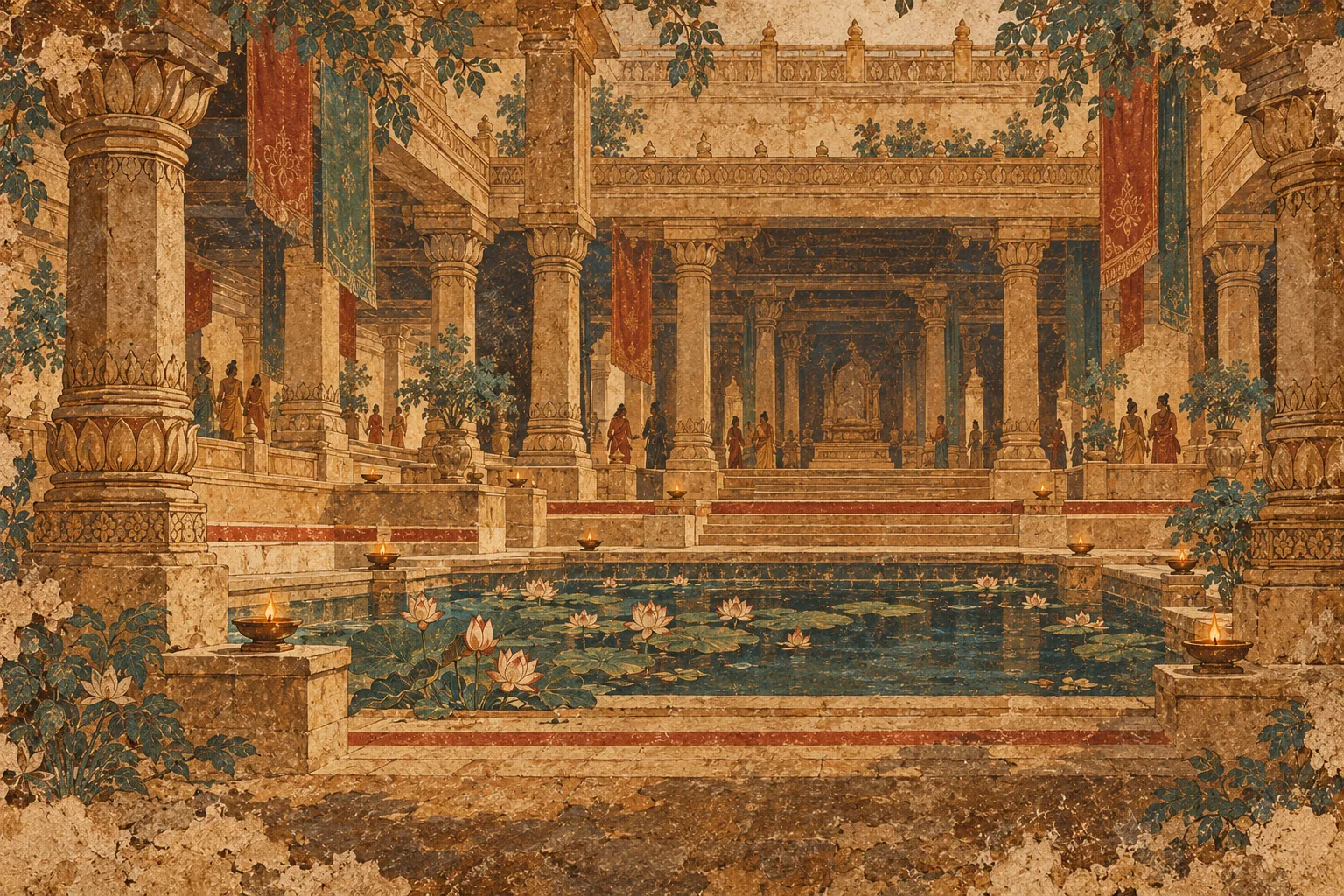
We tell the stories as the sources tell them, drawing on the complete texts rather than shortcuts, told in a way anyone can enjoy. Each episode is short enough to read with your morning tea, and illustrated in the spirit of ancient Indian murals.
We don’t preach, and we stay out of politics. These stories belong to everyone who loves them. They come from another age, too, so we tell them honestly, and telling a story is not endorsing every custom in it.